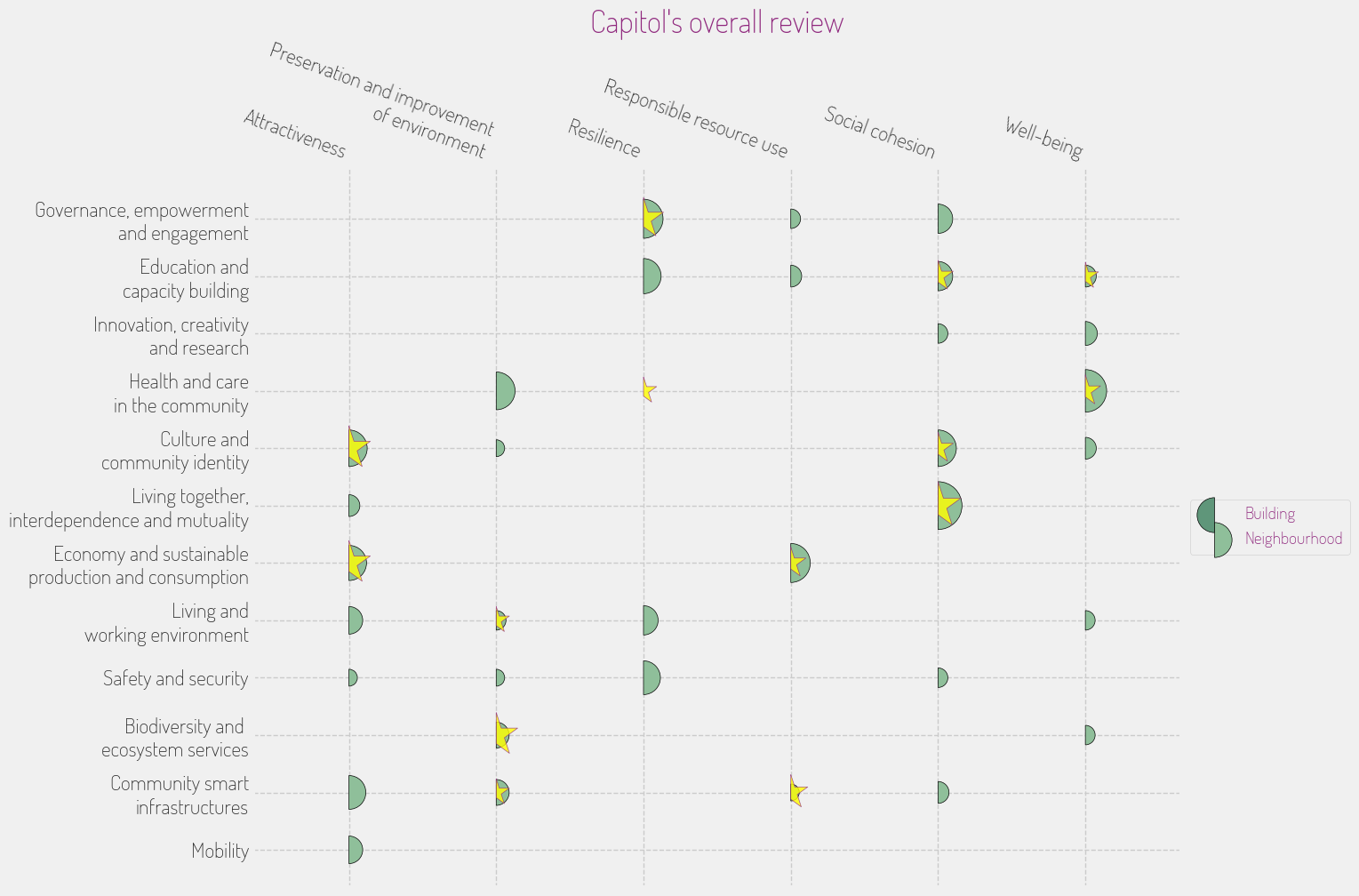
INITIATIVE PORTFOLIO
Initiative #1: Urban Resilience Hubs
Category: Community Safety & Resilience
Scale: City-wide
Lead Stakeholder Type: Government / Public-Private Partnership
Timeline: Immediate (< 6 months)
What it is: This initiative establishes urban resilience hubs across The Capitol, designed to provide resources during climate emergencies. Equipped with supplies, information, and community coordination spaces, these hubs will be strategically placed to ensure accessibility for vulnerable populations.
Why here: Given the Capitol’s reliance on elaborate energy systems and its vulnerability to climate impacts, these hubs will serve as critical safety nets, fostering resilience in a city defined by wealth disparity.
Who benefits most: Marginalized communities with less access to emergency resources during climate events.
Quick win or deep change: Quick win - the hubs can be established relatively swiftly.
Estimated complexity: Moderate - requires partnerships and community involvement.
Initiative #2: Green Mobility Network
Category: Mobility & Transportation
Scale: City-wide
Lead Stakeholder Type: Government
Timeline: Short (1 year)
What it is: The Green Mobility Network will enhance public transportation through the introduction of electric buses, extensive bike lanes, and pedestrian pathways, encouraging sustainable and eco-friendly commuting options across the city.
Why here: This initiative aligns with The Capitol’s ongoing transition to renewable energy and will provide low-cost transportation options for all residents, including those from lower-income districts.
Who benefits most: Daily commuters, especially from marginalized communities.
Quick win or deep change: Deep change - a shift in transportation culture and infrastructure is needed.
Estimated complexity: Complex - involves significant restructuring and investment.
Initiative #3: Community Art Festivals
Category: Arts, Culture & Heritage
Scale: Neighborhood
Lead Stakeholder Type: Community Group / Non-profit
Timeline: Medium (2-3 years)
What it is: Initiating regular neighborhood art festivals that highlight cultural diversity through performances, art exhibitions, and food stalls showcasing the crafts and cuisines from the various districts of Panem.
Why here: This effort would foster social cohesion and celebrate the rich cultural diversity that defines The Capitol, providing a platform for all community members to share their heritage.
Who benefits most: Local artists, small business owners, and residents seeking cultural expression.
Quick win or deep change: Quick win - can be organized with existing local talent.
Estimated complexity: Simple - leveraging existing community networks.
Initiative #4: Affordable Housing Cooperative
Category: Housing & Built Environment
Scale: District
Lead Stakeholder Type: Community Group / Non-profit
Timeline: Medium (2-3 years)
What it is: Form a cooperative model for developing affordable housing in the Capitol where residents can invest in and manage their housing units, promoting security and stability for lower-income families.
Why here: The pressing issue of gentrification and rising property prices necessitates innovative housing solutions to ensure that marginalized populations are not displaced.
Who benefits most: Low-income families and individuals seeking stable housing options.
Quick win or deep change: Deep change - aims to fundamentally alter housing dynamics in The Capitol.
Estimated complexity: Complex - requires legal and financial frameworks to support cooperative models.
Initiative #5: Circular Economy Workshops
Category: Economic Development & Local Business
Scale: Neighborhood
Lead Stakeholder Type: Non-profit/ Community Group
Timeline: Short (1 year)
What it is: These workshops will educate and empower local businesses and residents about the principles of the circular economy, including recycling, upcycling, and sustainable practices to reduce waste and create economic opportunities.
Why here: With a growing emphasis on sustainability within The Capitol, fostering local practices that support the circular economy will not only help the environment but can also empower entrepreneurs in underserved communities.
Who benefits most: Small business owners and residents invested in sustainability.
Quick win or deep change: Quick win - workshops can be started with minimal funding.
Estimated complexity: Simple - mainly requires resource persons and community engagement.
Initiative #6: Educational Mentoring Program
Category: Education & Skills
Scale: Neighborhood
Lead Stakeholder Type: Community Group
Timeline: Medium (2-3 years)
What it is: Establish a mentoring program pairing local professionals with youth from marginalized communities to provide guidance in education, career development, and life skills.
Why here: This will directly address the disparities in opportunities faced by lower-income youth, fostering empowerment and a pathway to success in a rapidly changing job market.
Who benefits most: Young people from lower-income families.
Quick win or deep change: Deep change - impacts youth development over the long term.
Estimated complexity: Moderate - requires recruitment and training of mentors.
Initiative #7: Urban Green Space Expansion
Category: Green Space & Environment
Scale: City-wide
Lead Stakeholder Type: Government / Public-Private Partnership
Timeline: Long (3+ years)
What it is: Develop underutilized spaces into urban parks and community gardens, ensuring all neighborhoods, especially economically disadvantaged ones, have access to green spaces.
Why here: The disparities in access to green spaces highlight a pressing need for the environmental justice principles in The Capitol, enhancing community health and well-being.
Who benefits most: All residents, particularly those in lower-income areas feeling the strain of limited green access.
Quick win or deep change: Deep change - reworks urban landscapes over time.
Estimated complexity: Complex - involves planning, funding, and community buy-in.
PORTFOLIO OVERVIEW
Interconnections:
- The Urban Resilience Hubs can serve as central points for the Green Mobility Network, providing information on transportation options during climate-related events.
- The Community Art Festivals can be hosted in the new Urban Green Spaces, reinforcing cultural identity and fostering community spirit while promoting environmental awareness.
Sequencing Recommendation:
Start with the Urban Resilience Hubs and Green Mobility Network, as these will provide immediate support for climate vulnerabilities and help establish foundational infrastructure for the other initiatives.
Coverage Check:
- Age groups served: Children, Youth, Working Age, Seniors
- Economic spectrum: Low-income, Middle-income
- Spatial distribution: Dispersed
Missing Voice:
The voice of specific marginalized communities, such as families affected by displacement from gentrification, might still be overlooked. Their unique challenges require targeted advocacy and support.